



News
Worldwide K-Beauty Platform SILICON2


Mapping Distribution Across 175 Countries: Silicon2’s Platform Strategy [Global K-Beauty Conference]
Kim Sung-woon, CEO of Silicon2
Connecting 7,500 global buyers
“Supply stability, not just product quality, is the key”
“Silicon2 is redrawing the global distribution map for K-beauty.”
At the “Global K-Beauty Conference 2026” held at Seoul Dragon City in Yongsan-gu, Seoul, on June 16, Silicon2 CEO Kim Sung-woon delivered a presentation titled “The Power of an Overseas Expansion Platform.” His message was that Silicon2 will connect Korean brands with buyers around the world so that K-beauty can reach overseas consumers faster and more reliably.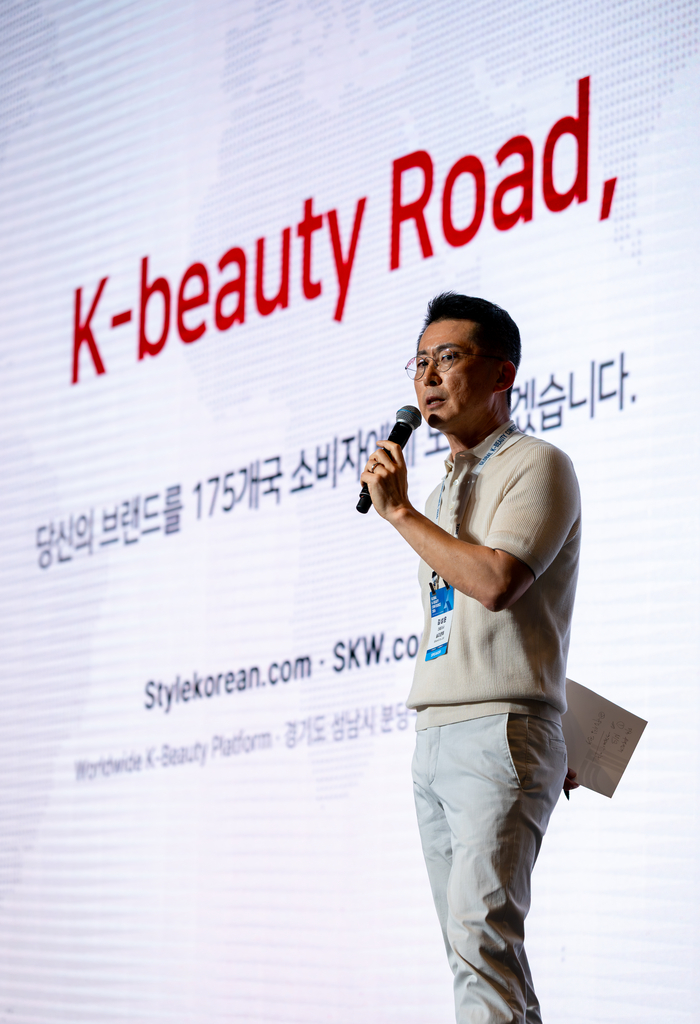 Kim Sung-woon, CEO of Silicon2, speaks on “The Power of an Overseas Expansion Platform” at the “Global K-Beauty Conference 2026” held at Seoul Dragon City in Yongsan-gu, Seoul, on June 16.
Silicon2 is a global K-beauty distributor, currently connected with more than 7,500 global buyers in 175 countries. In major markets including the U.S., Europe, the Middle East and Southeast Asia, the company manages distribution, logistics, inventory, sales and local support together.
“Brand companies don’t know overseas markets well, and overseas buyers find it hard to identify Korean brands on their own,” Kim said. “Silicon2 serves as a trusted link between the two.”
The key point Kim emphasized was “supply stability.” Large overseas retailers do not evaluate K-beauty brands on product quality alone. They also look at whether a brand can maintain sufficient local inventory, supply products without stockouts, and has an organization in place to respond when problems arise.
“Large platforms like iHerb ask whether a brand can keep three months of inventory in the U.S.,” Kim said. “Walmart and Target also place great importance on the financial capacity and operating systems needed to secure local inventory.”
To meet these demands, Silicon2 has strengthened its local inventory operations and direct purchasing structure. The company holds inventory at its Korean headquarters and at major hubs in the Americas, Europe and the Middle East, and supplies volumes in line with market growth. “Even with the risks involved, this is a structure we must have to meet the supply stability that global retailers require,” Kim stressed.
A representative example is the U.K. drugstore chain Boots. Silicon2 supplies K-beauty brands to Boots and maintains an order fulfillment rate of around 95%. The company also runs a dedicated Boots team, in which staff at its Korean headquarters and in Europe jointly serve as key account managers to respond to the retailer’s requests.
Another strength Silicon2 brings to negotiations with overseas retailers is its Korean market data. Overseas retailers want to know which products are actually selling well in Korea, but local distributors in Europe or the U.S. have difficulty tracking Korean market trends in real time. “Based on actual sales data, Silicon2 can recommend which products have the greatest growth potential,” Kim said.
The company is also rapidly expanding its overseas infrastructure. Silicon2 operates, or is preparing to open, more than 17 overseas subsidiaries and hubs. Its U.S. subsidiary was established in 2015, with logistics hubs in California on the West Coast and New Jersey on the East Coast.
In Europe, its Poland subsidiary serves as the hub. The company is also preparing to expand its bases in the Middle East, South America and Japan in line with each market’s characteristics.
Silicon2 is also growing its offline presence. Through its “Moida” stores, the company has created spaces where K-beauty brands can meet local consumers directly. Moida is not just a retail store; it serves as a testing ground where local consumers experience brands and brand owners gauge consumer response. Silicon2 plans to operate a total of 34 Moida stores by year-end in locations including the U.S., the U.K., France, Dubai and Indonesia.
Silicon2’s goal is to go beyond being a simple distributor and establish itself as a platform for K-beauty’s overseas expansion. It aims to assess and connect the dots comprehensively: which brands have potential in which markets, which retailers they should be linked with, and what inventory and logistics structure they need.
“There are many brands that make good products, but to survive in overseas markets over the long term, they need supply stability, local support and data-driven sales capabilities together,” Kim said. “We will work to ensure that good Korean brands reach consumers around the world faster and more reliably.”
- New post
- There is no new post.

CEO : Kim Sung-woon Business Registration Number : 214-87-03359 Landline : +82-70-8622-5826 Fax : +82-31-789-3851
Copyright (C) SILICON2 Co., LTD. All rights reserved.
- Privacy Policy
- We reject the unauthorized collection of any email addresses from our website